 |
The I ChingChapter 1 - The Basic Structure of the I Ching |
|
Tao, Yang and Yin
The structure for understanding the I Ching begins with the Tao. The Tao is the term for the pure force of the universe. It is whole, eternal, and ineffable. It is said in the Tao Te Ching, the masterpiece on the subject written by the master Lao Tzu, that “whatever can be described is not the Tao”.
The basic way to think of the Tao is to think of it as the concept of zero. It is emptiness, but also eternity.
The Tao itself can be seen at a variety of levels: as pure emptiness, as an emptiness that has a quality of emptiness, as an emptiness that has the quality of fullness (that is, an emptiness that is “pregnant with potential”), or as a vast fullness.
At that final level of understanding, of a vast fullness, one can at first understand this Tao as a completely undefined fullness, just full with a pure energy.
Beyond that, one can understand this “full Tao” as containing within it the forces of all opposites; that is the Tao as the “union of opposites”.
It is from this Tao that actual opposites emerge; and at their most basic, they are the positive and negative, the yes and the no, the black and white, light and dark, male and female, up and down, strong and weak, creative and receptive. In other words, they are the primordial opposites.
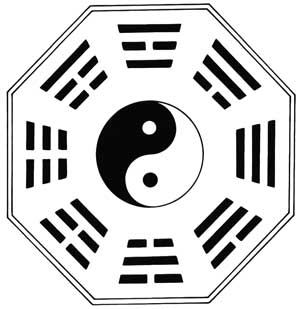
In the metaphysics of the I Ching, the term for these two forces are “yang” and “yin”. The “Yang” is the basic positive force. It is represented in the I Ching by a single straight unbroken line; thus, it is the 1.
The “Yin” is the basic negative force. It is represented in the I ching by a single line broken into two parts by a gap in the middle.
It is these lines, the unbroken Yang and broken Yin lines, that make up all the trigrams of the I ching.
The Trigrams
“Trigram” is the basic term for the symbols that represent the disparate elements that form the building blocks of the universe (as organized in the I Ching). They are called “trigrams” because they consist of three lines, each line being either a “yin” or “yang”.
As the Yang is 1, and Yin is 2, the subsequent elements that are composed of combinations of these must have 3 parts. This is because two lines of pure yin would just be yin, two lines of pure yang would just be yang, and the two lines composed of yin and yang would be just “yin and yang”.
In order for there to be something truly new that is born of the mixture of Yin and Yang, it is necessary for there to be a synthesis, a mix of three parts, that (excepting the two extremes of three pure yin lines or three pure yang lines) consist of an unequal mixture of the two forces (so that every mixed trigram will have either more yin or more yang). Likewise, the presence of three lines means that the location of the yin or yang lines (which is on top, which is on the bottom and which is in the middle) becomes important and creates difference.
The end result is the creation of eight trigrams, which represent eight fundamental forces in the alchemical universe of the I Ching. They are as follows:
"Chien": Heaven
Chien is the trigram traditionally translated as "Heaven". It is pure Yang, unbroken. It is the celestial power, all the energy of creating, strong, the cold force, the masculine, the phallus, light, the Father. It is the quality of forcefulness.
"Kun": The World
Kun is the trigram traditionally translated as "earth", but its meaning is "the world" (the opposite of Chien, which is "heaven"). Kun is pure Yin, broken lines. It is the worldly power, all the content of creation, weak, the hot force, the feminine, the yoni, darkness, the Mother. It is the quality of spaciousness.
"Li": The Sun
Li has traditionally been translated as "fire", but this is the concept of pure primordial fire, not the lesser elemental fire. Thus, the best translation is one that has sometimes been used: "The Sun". It is sometimes also referred to as "lightning". It is the trigram associated with Summer (when the Sun is at its strongest), beauty, the power of clinging. Because it is a single weak line between two strong ones, it is referred to as the Middle Daughter. Its quality is radiance.
"Kan": The Moon
Kan has been traditionally translated as "water", but in the same way that Li represents primordial fire, Li represents primordial water, thus another translation that has been attributed to it is one I find more appropriate: "The Moon". It is also referred to sometimes as the cloud, or the pit. It can represent "danger", because of its hidden power (a strong line surrounded by weak lines). It is associated with Winter (when the sun is at its weakest), the characteristic of enveloping; and because of the strong line in the middle it is called the "Middle Son". Its quality is deepness.
"Chen": The Fire Element
The trigram "Chen" is traditionally translated as "thunder", but its quality is that of the alchemical element of Fire. It is the active and moving force, the force of dynamic power, the arousing or energetic force. It is correspondent to springtime, the time of rising force. Because of its single strong line at the bottom (the first line of the trigram, because in the I Ching the lines are always read from the bottom to the top), it is called the Eldest Son. Its quality is vibration.
"Tui": The Water Element
The trigram "Tui" is traditionally translated as "lake", but its quality is that of the alchemical element of Water. It is the deep and still force. It corresponds to Autumn, when nature is slowing down. It is also sometimes translated as "a marsh"; it has the quality of the rain, of joy and relaxed pleasure. Because of its broken line at the top, it is called the Youngest Daughter. Its quality is openness.
"Sun": The Air Element
The trigram "Sun" is traditionally translated as "wind", but its quality is that of the alchemical element of Air. It is sometimes also translated as "wood", which is correspondent in Taoist alchemy to some of the concepts of the Air element. It has a gentle quality, but insistent. Because of its weak line at the bottom, it is called the Eldest Daughter. Its quality is consideration.
"Ken": The Earth Element
The trigram "Ken" is traditionally translated as "mountain", but its quality is that of the alchemical element of Earth. It is the immovable solid power, and has the quality of stubbornness and stuckness. Because of its strong line at the top, it is called the Youngest Son. Its quality is attachment.
Thus it can be understood that the unfolding of the Trigrams follows logical patterns which are worthy of countless hours of contemplation, and which important similarities to systems found in the west (such as the Kabbalah). The 0 of the Tao becomes the 1 and 2 of the Yang and Yin lines; these lines in their purest form express as the forces of Heaven and the World (the creative power and the creation). Mingling, these forces become the Sun and the Moon (the balance of the weak in the strong, and the balance of the strong in the weak). Then they express themselves as the four elements, representing less balanced mixtures of weak and strong forces. Fire is the “eldest son” force, a strong base with weak middle and top. Water is the “eldest daughter” force, a weak top with a strong base and middle. Air is the “youngest daughter” force, a weak bottom with a strong middle and top; and Earth is the “youngest son”, a strong top with a weak base and middle.
These eight forces, the Trigrams, combine with each other, mingling to form 64 different combinations representing different states. Here is where the expression of the I Ching reaches its peak and most practical function: it describes any situation or state of the moment as a combination of two main influences, one below and the other above, interacting with one another to create the particular conditions in a person’s life.

Copyright © 2026 by Swami Anand Nisarg. All rights reserved. This copyright protects Swami Anand Nisarg's right to publication of this work. Nonprofit, activist, and educational groups may circulate this work (forward it, reprint it, translate it, post it, or reproduce it) for nonprofit uses. Please do not change any part of it without permission.
« Introduction Download this entire work Return to the Library Chapter 2 »